Buy implantologie.info ?
We are moving the project
implantologie.info .
Are you interested in purchasing the domain
implantologie.info ?
domain@kv-gmbh.de · 0541-91531010
Buy implantologie.info ?
Are oral grades important?
Oral grades can be important as they provide an opportunity for students to demonstrate their understanding and communication skills in a different format than written assessments. They can also help teachers assess a student's ability to articulate their thoughts and ideas verbally, which is a valuable skill in many aspects of life. Additionally, oral grades can provide a more holistic view of a student's performance and comprehension of the material. **
Are the oral grades fair?
The fairness of oral grades can vary depending on the context and criteria used for evaluation. Factors such as consistency in grading, clear communication of expectations, and opportunities for students to demonstrate their understanding can contribute to the fairness of oral grades. It is important for educators to provide constructive feedback and support to help students improve their oral communication skills. Overall, the fairness of oral grades can be enhanced through transparent assessment practices and a focus on student growth and development. **


Similar search terms for Grades
Top-Angebote
Products related to Grades:
-
Scholastic Bargain Book Box Grades K-1 (100 Books)A box of books at the best price! Take advantage of inventory conditions that leave some of our books without a permanent home. The list of titles in this collection will change depending on availability. A super way to save money and send every...235,00 $*Shipping: 0,00 $Secure redirect to the provider
-
Learning Resources Math Tools Resource Kit: Grades K-1Support student success and raise key math standards of kindergartners and first graders with this Math Tools Resource Kit! Use the sets at independent stations or as shared resources during small-group instruction—three sets of reference cards...149,99 $*Shipping: 0,00 $Secure redirect to the provider
-
Scholastic School Success School Success Kit Grades K to 1In partnership with Valley of the Sun United Way and the Yale Child Study Center-Scholastic Collaborative for Child and Family Resilience, we have created materials designed to help families support their children's development. These research-based...45,32 $*Shipping: 0,00 $Secure redirect to the provider
-
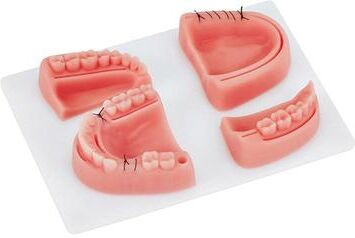
Inspired Deals Dental Suture Practice Model Silicone Oral Surgery Training Simulator For Students & Professionals Dental Suture Practice Model Silicone Oral Surgery Training Simulator For Students & ProfessionalsBuild confidence before performing real procedures with a realistic dental suture practice model designed to sharpen essential clinical skills. Created for dental students, medical trainees, educators, and healthcare professionals, this handson...49,97 $*Shipping: 0,00 $Secure redirect to the provider



-
Are oral participation grades fair?
Oral participation grades can be fair if they are based on clear and consistent criteria, and if all students have an equal opportunity to contribute. However, they can also be unfair if they favor certain communication styles or if they disproportionately benefit students who are more outgoing or confident. Teachers should consider alternative ways to assess participation, such as written reflections or small group discussions, to ensure that all students have a chance to demonstrate their understanding and engagement. Overall, the fairness of oral participation grades depends on how they are implemented and the efforts made to create an inclusive and equitable learning environment. **
-
How are oral grades calculated?
Oral grades are typically calculated based on a combination of factors such as participation, preparedness, communication skills, and content knowledge. Teachers may assess students based on their ability to actively engage in class discussions, ask and answer questions, and contribute to group activities. Additionally, students may be evaluated on their ability to articulate their thoughts clearly and effectively, as well as their overall understanding of the material being discussed. These factors are often used to determine a student's oral grade for a particular class or assignment. **
-
How are oral grades evaluated?
Oral grades are typically evaluated based on several criteria, including content, organization, delivery, and overall effectiveness. Content refers to the quality and accuracy of the information presented, while organization assesses the structure and coherence of the presentation. Delivery encompasses factors such as voice projection, eye contact, and body language, while overall effectiveness considers the impact of the presentation on the audience. Teachers may use rubrics or specific guidelines to assess these criteria and assign a grade based on the student's performance. **
-
Why are there oral grades?
Oral grades are important because they allow teachers to assess a student's ability to communicate effectively, think critically, and demonstrate understanding of the material through spoken language. Oral communication skills are essential for success in many aspects of life, including professional and social interactions. By evaluating students' oral performance, teachers can provide valuable feedback and support to help them improve their communication skills. Additionally, oral grades can provide a more comprehensive assessment of a student's overall understanding and mastery of the material, complementing written assessments. **

Are the oral grades bad?
It is difficult to determine if the oral grades are bad without more context. The quality of oral grades can depend on various factors such as the difficulty of the material, the expectations of the instructor, and the individual student's performance. It is important to communicate with the instructor to understand their expectations and seek feedback on how to improve oral grades. Additionally, seeking out resources such as tutoring or practice opportunities can help improve oral grades. **
What are the differences between oral grades and written grades?
Oral grades are typically given based on a student's performance in verbal assessments or presentations, while written grades are based on written assignments or exams. Oral grades may reflect a student's ability to communicate effectively, think on their feet, and demonstrate understanding in real-time, while written grades may assess a student's ability to organize thoughts, provide detailed explanations, and demonstrate mastery of the material through writing. Additionally, oral grades may be more subjective and influenced by factors such as presentation skills and confidence, while written grades are often more objective and based on the content of the written work. **
Top-Angebote
Products related to Grades:
-
Scholastic Bargain Book Box Grades K-1 (100 Books)A box of books at the best price! Take advantage of inventory conditions that leave some of our books without a permanent home. The list of titles in this collection will change depending on availability. A super way to save money and send every...235,00 $*Shipping: 0,00 $Secure redirect to the provider
-
Learning Resources Math Tools Resource Kit: Grades K-1Support student success and raise key math standards of kindergartners and first graders with this Math Tools Resource Kit! Use the sets at independent stations or as shared resources during small-group instruction—three sets of reference cards...149,99 $*Shipping: 0,00 $Secure redirect to the provider
-
Are oral grades important?
Oral grades can be important as they provide an opportunity for students to demonstrate their understanding and communication skills in a different format than written assessments. They can also help teachers assess a student's ability to articulate their thoughts and ideas verbally, which is a valuable skill in many aspects of life. Additionally, oral grades can provide a more holistic view of a student's performance and comprehension of the material. **
-
Are the oral grades fair?
The fairness of oral grades can vary depending on the context and criteria used for evaluation. Factors such as consistency in grading, clear communication of expectations, and opportunities for students to demonstrate their understanding can contribute to the fairness of oral grades. It is important for educators to provide constructive feedback and support to help students improve their oral communication skills. Overall, the fairness of oral grades can be enhanced through transparent assessment practices and a focus on student growth and development. **
-
Are oral participation grades fair?
Oral participation grades can be fair if they are based on clear and consistent criteria, and if all students have an equal opportunity to contribute. However, they can also be unfair if they favor certain communication styles or if they disproportionately benefit students who are more outgoing or confident. Teachers should consider alternative ways to assess participation, such as written reflections or small group discussions, to ensure that all students have a chance to demonstrate their understanding and engagement. Overall, the fairness of oral participation grades depends on how they are implemented and the efforts made to create an inclusive and equitable learning environment. **
-
How are oral grades calculated?
Oral grades are typically calculated based on a combination of factors such as participation, preparedness, communication skills, and content knowledge. Teachers may assess students based on their ability to actively engage in class discussions, ask and answer questions, and contribute to group activities. Additionally, students may be evaluated on their ability to articulate their thoughts clearly and effectively, as well as their overall understanding of the material being discussed. These factors are often used to determine a student's oral grade for a particular class or assignment. **
Similar search terms for Grades
-
Scholastic School Success School Success Kit Grades K to 1In partnership with Valley of the Sun United Way and the Yale Child Study Center-Scholastic Collaborative for Child and Family Resilience, we have created materials designed to help families support their children's development. These research-based...45,32 $*Shipping: 0,00 $Secure redirect to the provider
-
Inspired Deals Dental Suture Practice Model Silicone Oral Surgery Training Simulator For Students & Professionals Dental Suture Practice Model Silicone Oral Surgery Training Simulator For Students & ProfessionalsBuild confidence before performing real procedures with a realistic dental suture practice model designed to sharpen essential clinical skills. Created for dental students, medical trainees, educators, and healthcare professionals, this handson...49,97 $*Shipping: 0,00 $Secure redirect to the provider
-
Fimo Pontefix Dental Prosthesis Adhesive 50 grHealth and Beauty Oral Care Fimo Pontefix Dental Prosthesis Adhesive 50 gr Pontefix Denture Adhesive 50g is a professional adhesive specially formulated to provide a secure and long-lasting hold for dentures. Thanks to its innovative composition, it guarantees a firm fit all day long, preventing shifting or discomfort, and providing greater comfort for the wearer. Its creamy texture allows for easy and even application, perfectly adapting to the surface of the denture and ensuring a reliable and comfortable wearing experience . Pontefix is the ideal solution for keeping your dentures stable and enjoying the security you need for everyday activities like speaking and eating. Benefits • Provides a durable fixation for partial or complete dentures. • It prevents the prosthesis from moving or causing discomfort during the day. • Improves comfort when chewing, speaking and smiling. • Creamy texture that allows for easy and even application . • Compatible with most dental prosthesis materials. • Reduces irritation and discomfort in the gums. • Reliable and safe formula, developed specifically for denture care. • 50g container, enough for prolonged and practical use at home. Who is it for? • People who use partial or complete dentures. • Ideal for those seeking a secure and stable fit throughout the day. • Recommended for users who experience movement or slippage of the prosthesis. • Perfect for adults who want to increase comfort when eating, speaking, or performing daily activities. • Suitable for any user looking for a reliable and easy-to-apply solution for their dentures. How do I apply it? • Clean and dry the prosthesis before applying the adhesive to ensure better adhesion. • Place a small amount of Pontefix Denture Adhesive on the areas in contact with the gums. • Distribute the product evenly, avoiding excess that could seep outside the prosthesis. • Insert the prosthesis into your mouth and press gently for a few seconds to ensure a secure fit. • Remove any excess adhesive that may ooze out over the edges. • To remove the prosthesis, make gentle movements and rinse with warm water to remove adhesive residue. Product Use • Daily use according to the need for prosthesis fixation. • Ensures stability and comfort during activities such as talking, eating, or smiling. • Compatible with daily cleaning of the prosthesis; it is recommended to remove and clean the prosthesis every night. • Store in a cool, dry place, out of reach of children. • Product safe for oral use and specifically formulated for the care of dental prostheses. Buy Pontefix Dental Prosthesis Adhesive 50 gr Pontefix Denture Adhesive 50g is available in pharmacies, drugstores, and online stores specializing in oral health. Purchasing this adhesive guarantees a reliable and comfortable hold for your dentures, ensuring you can carry out your daily activities safely and comfortably. Its 50g container provides a sufficient supply for extended use, combining effectiveness, comfort, and...29,37 £*Shipping: 3,99 £Secure redirect to the provider
-
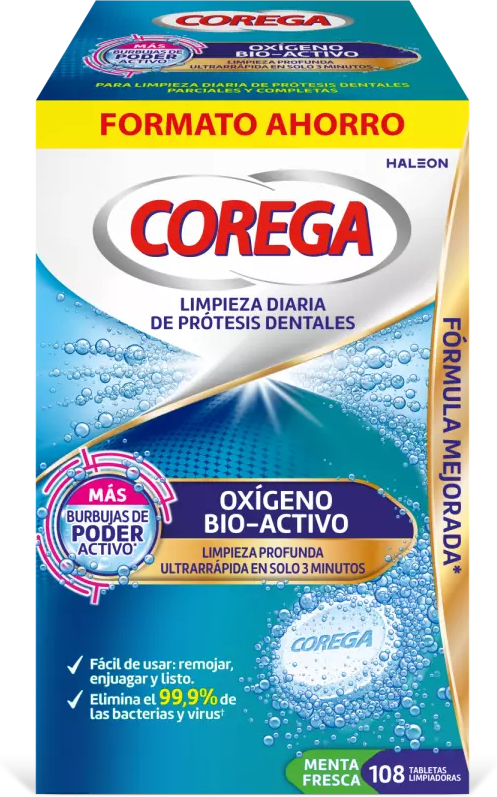
Corega Bioactive Oxygen Dental Prosthesis Cleaning 108 UnitsHealth and Beauty Oral Care Corega Bioactive Oxygen Dental Prosthesis Cleaning 108 Units Partial denture tablets help protect natural teeth as part of good daily oral hygiene. For good daily oral hygiene: 1. Brush your natural teeth twice a day with a fluoride toothpaste. 2. Wash your partial denture daily with cleanser and protects. 3. Use seal and protect to stabilize your partial denture. 4. Visit your dentist regularly (every 6 months). Instructions for use: Place one tablet in a container with enough warm water (not too much) to cover the partial denture. Leave the partial denture immersed in the solution for 3-5 minutes. For best results, brush the partial denture with a soft toothbrush. Rinse the partial denture thoroughly with water. Discard any remaining solution immediately after use. Precautions for use: - Do not touch your eyes or mouth after handling the tablets or solution. - Do not use if you are allergic to any of the ingredients. - Do not place tablets or solution in your mouth. - Do not drink the cleaning solution or use it as a mouthwash.16,18 £*Shipping: 3,99 £Secure redirect to the provider
-
How are oral grades evaluated?
Oral grades are typically evaluated based on several criteria, including content, organization, delivery, and overall effectiveness. Content refers to the quality and accuracy of the information presented, while organization assesses the structure and coherence of the presentation. Delivery encompasses factors such as voice projection, eye contact, and body language, while overall effectiveness considers the impact of the presentation on the audience. Teachers may use rubrics or specific guidelines to assess these criteria and assign a grade based on the student's performance. **
-
Why are there oral grades?
Oral grades are important because they allow teachers to assess a student's ability to communicate effectively, think critically, and demonstrate understanding of the material through spoken language. Oral communication skills are essential for success in many aspects of life, including professional and social interactions. By evaluating students' oral performance, teachers can provide valuable feedback and support to help them improve their communication skills. Additionally, oral grades can provide a more comprehensive assessment of a student's overall understanding and mastery of the material, complementing written assessments. **
-
Are the oral grades bad?
It is difficult to determine if the oral grades are bad without more context. The quality of oral grades can depend on various factors such as the difficulty of the material, the expectations of the instructor, and the individual student's performance. It is important to communicate with the instructor to understand their expectations and seek feedback on how to improve oral grades. Additionally, seeking out resources such as tutoring or practice opportunities can help improve oral grades. **
-
What are the differences between oral grades and written grades?
Oral grades are typically given based on a student's performance in verbal assessments or presentations, while written grades are based on written assignments or exams. Oral grades may reflect a student's ability to communicate effectively, think on their feet, and demonstrate understanding in real-time, while written grades may assess a student's ability to organize thoughts, provide detailed explanations, and demonstrate mastery of the material through writing. Additionally, oral grades may be more subjective and influenced by factors such as presentation skills and confidence, while written grades are often more objective and based on the content of the written work. **
* All prices are inclusive of VAT and, if applicable, plus shipping costs. The offer information is based on the details provided by the respective shop and is updated through automated processes. Real-time updates do not occur, so deviations can occur in individual cases. ** Note: Parts of this content were created by AI.