Buy implantologie.info ?
We are moving the project
implantologie.info .
Are you interested in purchasing the domain
implantologie.info ?
domain@kv-gmbh.de · 0541-91531010
Buy implantologie.info ?
What were the Reformation and Counter-Reformation?
The Reformation was a 16th-century movement within Christianity that aimed to reform the Roman Catholic Church. It was led by figures such as Martin Luther, John Calvin, and Huldrych Zwingli, who sought to address corruption and abuses within the Church. The Counter-Reformation, on the other hand, was the Catholic Church's response to the Reformation. It involved efforts to reaffirm and strengthen Catholic doctrine, as well as to address some of the criticisms raised by the reformers. The Council of Trent, held between 1545 and 1563, was a key event in the Counter-Reformation, as it outlined reforms and clarified Catholic teachings. **
What was the Reformation and the Counter-Reformation?
The Reformation was a 16th-century movement in Europe that sought to reform the Roman Catholic Church and resulted in the creation of Protestantism. It was sparked by Martin Luther's 95 Theses, which criticized the Church's practices and teachings. The Counter-Reformation was the Catholic Church's response to the Reformation, aiming to address the issues raised by the reformers and to reassert the Church's authority. It included efforts to reform the Church from within, as well as the establishment of the Inquisition to combat heresy. **


Similar search terms for Reformation
Top-Angebote
Products related to Reformation:
-
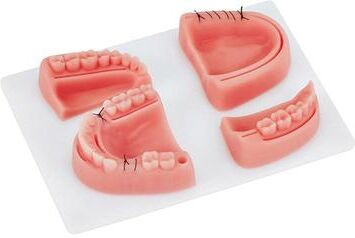
Inspired Deals Dental Suture Practice Model Silicone Oral Surgery Training Simulator For Students & Professionals Dental Suture Practice Model Silicone Oral Surgery Training Simulator For Students & ProfessionalsBuild confidence before performing real procedures with a realistic dental suture practice model designed to sharpen essential clinical skills. Created for dental students, medical trainees, educators, and healthcare professionals, this handson...49,97 $*Shipping: 0,00 $Secure redirect to the provider
-
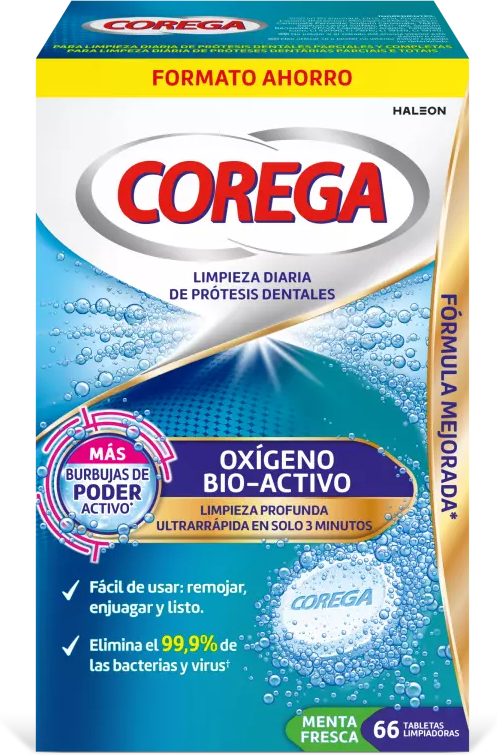
Corega Bioactive Oxygen Dental Prosthesis Cleaning 66 UnitsHealth and Beauty Oral Care Corega Bioactive Oxygen Dental Prosthesis Cleaning 66 Units Partial denture tablets help protect natural teeth as part of good daily oral hygiene. For good daily oral hygiene: 1. Brush your natural teeth twice a day with a fluoride toothpaste. 2. Wash your partial denture daily with cleanser and protects. 3. Use seal and protect to stabilize your partial denture. 4. Visit your dentist regularly (every 6 months). Instructions for use: Place one tablet in a container with enough warm water (not too much) to cover the partial denture. Leave the partial denture immersed in the solution for 3-5 minutes. For best results, brush the partial denture with a soft toothbrush. Rinse the partial denture thoroughly with water. Discard any remaining solution immediately after use. Precautions for use: - Do not touch your eyes or mouth after handling the tablets or solution. - Do not use if you are allergic to any of the ingredients. - Do not place tablets or solution in your mouth. - Do not drink the cleaning solution or use it as a mouthwash.13,55 £*Shipping: 3,99 £Secure redirect to the provider
-
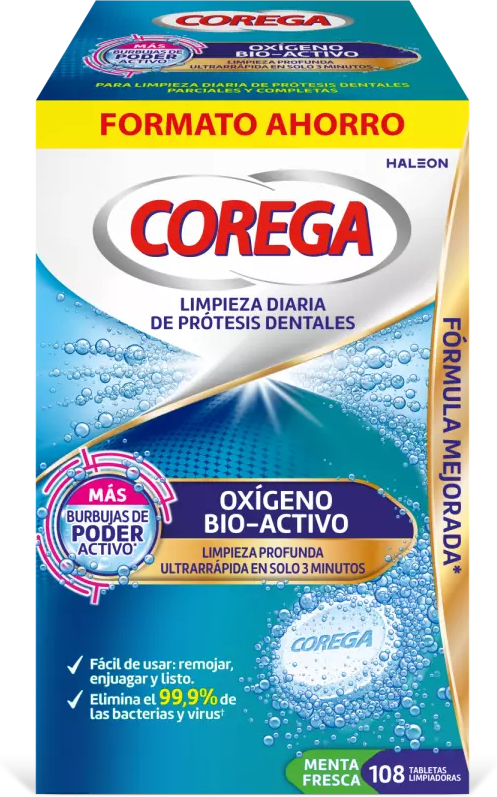
Corega Bioactive Oxygen Dental Prosthesis Cleaning 108 UnitsHealth and Beauty Oral Care Corega Bioactive Oxygen Dental Prosthesis Cleaning 108 Units Partial denture tablets help protect natural teeth as part of good daily oral hygiene. For good daily oral hygiene: 1. Brush your natural teeth twice a day with a fluoride toothpaste. 2. Wash your partial denture daily with cleanser and protects. 3. Use seal and protect to stabilize your partial denture. 4. Visit your dentist regularly (every 6 months). Instructions for use: Place one tablet in a container with enough warm water (not too much) to cover the partial denture. Leave the partial denture immersed in the solution for 3-5 minutes. For best results, brush the partial denture with a soft toothbrush. Rinse the partial denture thoroughly with water. Discard any remaining solution immediately after use. Precautions for use: - Do not touch your eyes or mouth after handling the tablets or solution. - Do not use if you are allergic to any of the ingredients. - Do not place tablets or solution in your mouth. - Do not drink the cleaning solution or use it as a mouthwash.16,18 £*Shipping: 3,99 £Secure redirect to the provider
-
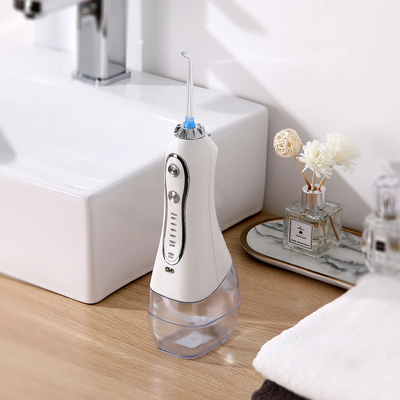
GreatGadgets LLC Oral Cordless Dental Flosser Oral Cordless Dental FlosserHave you ever tried to figure out the main reason of teeth cavity It is bacteria and dirt that are left in the hardtoreach teeth areas. So want to clean these areas No worries – simply get your hands at this Oral Cordless Dental Flosser. This...89,97 $*Shipping: 0,00 $Secure redirect to the provider
-
Why were numerous universities founded during the Reformation and Counter-Reformation era?
Numerous universities were founded during the Reformation and Counter-Reformation era because of the increased demand for education and the need to train clergy and scholars in the theological and philosophical debates of the time. The Reformation led to a greater emphasis on the study of scripture and theology, prompting the establishment of Protestant universities to train ministers and scholars in these areas. On the other hand, the Counter-Reformation, led by the Catholic Church, also saw the founding of universities to educate clergy and counter the spread of Protestant ideas. Additionally, the printing press allowed for the dissemination of knowledge, leading to a greater demand for education and the establishment of more universities. **
-
Does the Princes' Reformation differ significantly from the People's Reformation under Luther?
Yes, the Princes' Reformation and the People's Reformation under Luther differ significantly. The Princes' Reformation was driven by political and economic motivations, as many German princes saw an opportunity to gain power and wealth by breaking away from the authority of the Catholic Church. On the other hand, the People's Reformation was more focused on religious and spiritual concerns, with Luther's teachings resonating with the common people who were seeking a more personal and direct relationship with God. Additionally, the Princes' Reformation often involved the use of force and coercion to implement religious changes, while the People's Reformation was more grassroots and organic in nature. **
-
What was the Counter-Reformation?
The Counter-Reformation was a period of Catholic resurgence in response to the Protestant Reformation. It was a movement within the Catholic Church to address the criticisms and challenges posed by the Protestant reformers. The Counter-Reformation involved efforts to reform the Church from within, combat heresy, and strengthen Catholic doctrine and practices. It also led to the founding of new religious orders, such as the Jesuits, to spread Catholicism and combat the spread of Protestantism. **
-
How was it before the Reformation?
Before the Reformation, the Catholic Church held significant power and influence over many aspects of society in Europe. The Church was the dominant religious institution, with a strong hierarchy led by the Pope in Rome. It controlled religious practices, education, and even had a say in political matters. The Church also collected tithes and sold indulgences, which were seen as a way to reduce punishment for sins. However, there were also criticisms of the Church's practices, such as corruption among clergy members, the selling of indulgences, and the lack of access to religious texts for the common people. These criticisms eventually led to the Reformation, a movement that sought to reform the Catholic Church and ultimately resulted in the establishment of Protestantism as a separate branch of Christianity. **


Is there a reformation among Catholics?
Yes, there have been movements within the Catholic Church that can be seen as a form of reformation. One example is the Second Vatican Council in the 1960s, which brought significant changes to the Church's practices and teachings. Additionally, there are ongoing discussions and debates within the Church about various issues, such as the role of women, the handling of sexual abuse scandals, and the approach to social justice. These movements can be seen as efforts to reform and renew the Catholic Church in response to the changing world. **
Why did Reformation Day become Halloween?
Reformation Day, which commemorates the day Martin Luther nailed his 95 Theses to the church door in Wittenberg, Germany, on October 31, 1517, is the same day as Halloween. The connection between the two dates is likely due to the fact that Halloween, or All Hallows' Eve, falls on the night before All Saints' Day, a Christian holiday. Over time, the traditions and customs of Halloween, such as dressing up in costumes and going door-to-door for treats, have become more prominent, overshadowing the religious significance of Reformation Day. As a result, the two events have become intertwined in popular culture. **
Top-Angebote
Products related to Reformation:
-
Oradent Dental Prosthesis BrushHealth and Beauty Oral Care Oradent Dental Prosthesis Brush Oradent F Dental Prosthesis Brush Oradent F Dental Prosthesis Brush is a brush specially designed for cleaning dental prostheses, such as dentures, bridges and other orthodontic devices. With soft and flexible bristles, this brush effectively removes food debris, bacteria and plaque accumulated on the prosthesis, ensuring complete oral hygiene and protecting the health of your gums and natural teeth. Its ergonomic design and compact size make it easy to use, ideal for keeping your dentures in perfect condition. Benefits of Oradent F Dental Prosthesis Brush Effective and gentle cleaning: The soft bristles of the Oradent F Denture Brush remove food debris and plaque without damaging the surface of the denture. Infection Prevention: Using this brush regularly helps prevent the buildup of bacteria and fungi, which can cause bad breath or mouth infections. Ergonomic design: Its ergonomic handle makes it easier to grip and use the brush, allowing for more comfortable and precise cleaning. Easy access to difficult areas: The bristles are arranged in a way that allows easy access to the corners and surfaces of the prosthesis, ensuring complete cleaning. Compatibility with all types of prosthetics: Ideal for dentures, bridges and other orthodontic devices, ensuring that any type of prosthesis remains clean and free of debris. Who is Oradent F Denture Brush for? Oradent F Denture Brush is specially designed for people who wear dental prostheses, such as dentures, bridges or implants. It is perfect for those who need to keep their prosthesis clean and free of bacteria on a daily basis. In addition, it is ideal for people with sensitive gums or who wear dentures for a long time, as its soft bristles protect the health of the gums and do not damage the dentures. If you are looking for a brush that offers a gentle but effective cleaning for your dentures, this is the right product. How do I apply it? Using the Oradent F Denture Brush is simple. Here's how to get the most out of it: Wet the brush: Before using the brush, wet the bristles with warm water. This will help soften food residue and make cleaning easier. Apply some toothpaste: Place a small amount of toothpaste on the bristles of the toothbrush. It is recommended to use a toothpaste suitable for dentures. Clean your denture: Gently brush the surfaces of the denture, making sure to clean all areas, including the edges and corners. Use gentle strokes to avoid damaging the denture. Rinse well: After brushing, rinse your dentures with warm water to remove any toothpaste residue or food debris. Use the brush daily: Use this brush as part of your daily cleaning routine to keep your dentures in good condition and prevent bacteria buildup. Product Usage Oradent F Denture Brush should be used regularly as part of daily oral hygiene. Its proper use ensures that your denture remains clean and free of food debris, plaque and bacteria, preventing...5,39 £*Shipping: 3,99 £Secure redirect to the provider
-
Inspired Deals Dental Suture Practice Model Silicone Oral Surgery Training Simulator For Students & Professionals Dental Suture Practice Model Silicone Oral Surgery Training Simulator For Students & ProfessionalsBuild confidence before performing real procedures with a realistic dental suture practice model designed to sharpen essential clinical skills. Created for dental students, medical trainees, educators, and healthcare professionals, this handson...49,97 $*Shipping: 0,00 $Secure redirect to the provider
-
Corega Bioactive Oxygen Dental Prosthesis Cleaning 66 UnitsHealth and Beauty Oral Care Corega Bioactive Oxygen Dental Prosthesis Cleaning 66 Units Partial denture tablets help protect natural teeth as part of good daily oral hygiene. For good daily oral hygiene: 1. Brush your natural teeth twice a day with a fluoride toothpaste. 2. Wash your partial denture daily with cleanser and protects. 3. Use seal and protect to stabilize your partial denture. 4. Visit your dentist regularly (every 6 months). Instructions for use: Place one tablet in a container with enough warm water (not too much) to cover the partial denture. Leave the partial denture immersed in the solution for 3-5 minutes. For best results, brush the partial denture with a soft toothbrush. Rinse the partial denture thoroughly with water. Discard any remaining solution immediately after use. Precautions for use: - Do not touch your eyes or mouth after handling the tablets or solution. - Do not use if you are allergic to any of the ingredients. - Do not place tablets or solution in your mouth. - Do not drink the cleaning solution or use it as a mouthwash.13,55 £*Shipping: 3,99 £Secure redirect to the provider
-
What were the Reformation and Counter-Reformation?
The Reformation was a 16th-century movement within Christianity that aimed to reform the Roman Catholic Church. It was led by figures such as Martin Luther, John Calvin, and Huldrych Zwingli, who sought to address corruption and abuses within the Church. The Counter-Reformation, on the other hand, was the Catholic Church's response to the Reformation. It involved efforts to reaffirm and strengthen Catholic doctrine, as well as to address some of the criticisms raised by the reformers. The Council of Trent, held between 1545 and 1563, was a key event in the Counter-Reformation, as it outlined reforms and clarified Catholic teachings. **
-
What was the Reformation and the Counter-Reformation?
The Reformation was a 16th-century movement in Europe that sought to reform the Roman Catholic Church and resulted in the creation of Protestantism. It was sparked by Martin Luther's 95 Theses, which criticized the Church's practices and teachings. The Counter-Reformation was the Catholic Church's response to the Reformation, aiming to address the issues raised by the reformers and to reassert the Church's authority. It included efforts to reform the Church from within, as well as the establishment of the Inquisition to combat heresy. **
-
Why were numerous universities founded during the Reformation and Counter-Reformation era?
Numerous universities were founded during the Reformation and Counter-Reformation era because of the increased demand for education and the need to train clergy and scholars in the theological and philosophical debates of the time. The Reformation led to a greater emphasis on the study of scripture and theology, prompting the establishment of Protestant universities to train ministers and scholars in these areas. On the other hand, the Counter-Reformation, led by the Catholic Church, also saw the founding of universities to educate clergy and counter the spread of Protestant ideas. Additionally, the printing press allowed for the dissemination of knowledge, leading to a greater demand for education and the establishment of more universities. **
-
Does the Princes' Reformation differ significantly from the People's Reformation under Luther?
Yes, the Princes' Reformation and the People's Reformation under Luther differ significantly. The Princes' Reformation was driven by political and economic motivations, as many German princes saw an opportunity to gain power and wealth by breaking away from the authority of the Catholic Church. On the other hand, the People's Reformation was more focused on religious and spiritual concerns, with Luther's teachings resonating with the common people who were seeking a more personal and direct relationship with God. Additionally, the Princes' Reformation often involved the use of force and coercion to implement religious changes, while the People's Reformation was more grassroots and organic in nature. **
Similar search terms for Reformation
-
Corega Bioactive Oxygen Dental Prosthesis Cleaning 108 UnitsHealth and Beauty Oral Care Corega Bioactive Oxygen Dental Prosthesis Cleaning 108 Units Partial denture tablets help protect natural teeth as part of good daily oral hygiene. For good daily oral hygiene: 1. Brush your natural teeth twice a day with a fluoride toothpaste. 2. Wash your partial denture daily with cleanser and protects. 3. Use seal and protect to stabilize your partial denture. 4. Visit your dentist regularly (every 6 months). Instructions for use: Place one tablet in a container with enough warm water (not too much) to cover the partial denture. Leave the partial denture immersed in the solution for 3-5 minutes. For best results, brush the partial denture with a soft toothbrush. Rinse the partial denture thoroughly with water. Discard any remaining solution immediately after use. Precautions for use: - Do not touch your eyes or mouth after handling the tablets or solution. - Do not use if you are allergic to any of the ingredients. - Do not place tablets or solution in your mouth. - Do not drink the cleaning solution or use it as a mouthwash.16,18 £*Shipping: 3,99 £Secure redirect to the provider
-
GreatGadgets LLC Oral Cordless Dental Flosser Oral Cordless Dental FlosserHave you ever tried to figure out the main reason of teeth cavity It is bacteria and dirt that are left in the hardtoreach teeth areas. So want to clean these areas No worries – simply get your hands at this Oral Cordless Dental Flosser. This...89,97 $*Shipping: 0,00 $Secure redirect to the provider
-
Oral-B iO3 dental care setOral-B iO3, 6 pc, Magnetic Toothbrushes unisex, Discover a practical bundle of products designed to enhance your everyday moments. Oral-BiO3 set takes the hassle out of choosing by offering a combination of popular products. Now available together in one convenient pack. The set contains: Oral-B iO3 electric toothbrush 1 pc Oral-B iO Ultimate Clean toothbrush replacement heads 4 pc Oral-B Pro Expert Gentle Whitening whitening toothpaste 75 ml Characteristics: bargain set ideal as a gift also suitable for people with sensitive teeth and gums the pressure sensor protects the gums by alerting you if you press too hard when brushing the round head easily cleans even places that are difficult to reach if using a toothbrush with a regular oblong head the timer monitors the correct intervals for brushing and also warns you when to change the brushing area How to use: Use according to the instructions included.87,00 £*Shipping: 3,99 £Secure redirect to the provider
-
Oral-B iO5 dental care setOral-B iO5, 6 pc, Magnetic Toothbrushes unisex, Discover a practical bundle of products designed to enhance your everyday moments. Oral-BiO5 set takes the hassle out of choosing by offering a combination of popular products. Now available together in one convenient pack. The set contains: Oral-B iO5 electric toothbrush with bag 1 pc Oral-B iO Ultimate Clean toothbrush replacement heads 4 pc Oral-B Pro Expert Gentle Whitening whitening toothpaste 75 ml Characteristics: bargain set ideal as a gift fights tooth decay and plaque the timer monitors the correct intervals for brushing and also warns you when to change the brushing area the pressure sensor protects the gums by alerting you if you press too hard when brushing also suitable for people with sensitive teeth and gums very soft bristles removes up to 100% more plaque than a manual toothbrush the round toothbrush head surrounds each tooth with precision How to use: Use according to the instructions included.130,90 £*Shipping: 3,99 £Secure redirect to the provider
-
What was the Counter-Reformation?
The Counter-Reformation was a period of Catholic resurgence in response to the Protestant Reformation. It was a movement within the Catholic Church to address the criticisms and challenges posed by the Protestant reformers. The Counter-Reformation involved efforts to reform the Church from within, combat heresy, and strengthen Catholic doctrine and practices. It also led to the founding of new religious orders, such as the Jesuits, to spread Catholicism and combat the spread of Protestantism. **
-
How was it before the Reformation?
Before the Reformation, the Catholic Church held significant power and influence over many aspects of society in Europe. The Church was the dominant religious institution, with a strong hierarchy led by the Pope in Rome. It controlled religious practices, education, and even had a say in political matters. The Church also collected tithes and sold indulgences, which were seen as a way to reduce punishment for sins. However, there were also criticisms of the Church's practices, such as corruption among clergy members, the selling of indulgences, and the lack of access to religious texts for the common people. These criticisms eventually led to the Reformation, a movement that sought to reform the Catholic Church and ultimately resulted in the establishment of Protestantism as a separate branch of Christianity. **
-
Is there a reformation among Catholics?
Yes, there have been movements within the Catholic Church that can be seen as a form of reformation. One example is the Second Vatican Council in the 1960s, which brought significant changes to the Church's practices and teachings. Additionally, there are ongoing discussions and debates within the Church about various issues, such as the role of women, the handling of sexual abuse scandals, and the approach to social justice. These movements can be seen as efforts to reform and renew the Catholic Church in response to the changing world. **
-
Why did Reformation Day become Halloween?
Reformation Day, which commemorates the day Martin Luther nailed his 95 Theses to the church door in Wittenberg, Germany, on October 31, 1517, is the same day as Halloween. The connection between the two dates is likely due to the fact that Halloween, or All Hallows' Eve, falls on the night before All Saints' Day, a Christian holiday. Over time, the traditions and customs of Halloween, such as dressing up in costumes and going door-to-door for treats, have become more prominent, overshadowing the religious significance of Reformation Day. As a result, the two events have become intertwined in popular culture. **
* All prices are inclusive of VAT and, if applicable, plus shipping costs. The offer information is based on the details provided by the respective shop and is updated through automated processes. Real-time updates do not occur, so deviations can occur in individual cases. ** Note: Parts of this content were created by AI.